Article
How Net Metering Works in Virginia
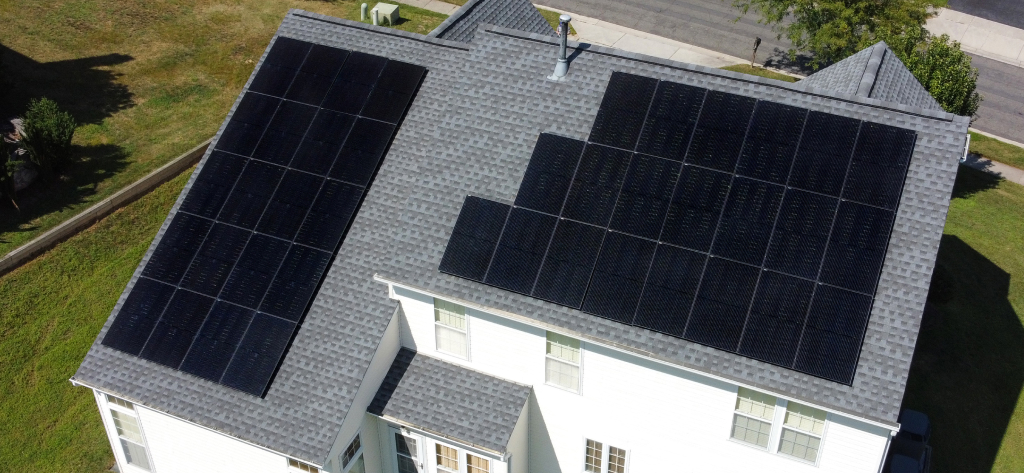
Virginia’s net metering rules are on the verge of their biggest change in years. The State Corporation Commission (SCC) must issue a ruling by May 1, 2026, on Dominion Energy’s proposal to cut the value of solar credits for new customers. Homeowners who go solar before that order takes effect will be locked into the current 1:1 retail rate for the life of their system, along with all the savings that come with it.
If you have been considering solar, that deadline matters.
What Is Net Metering?
Solar panels rarely match your home’s electricity use hour by hour. They produce more than you need on sunny afternoons and nothing at all overnight. Net metering solves that mismatch by turning the grid into a two-way exchange.
When your panels generate more electricity than your home uses, the excess flows to the grid. Your utility credits that energy against what you pull back on cloudy days, overnight, and during winter. In Virginia, those credits accumulate over a 12-month period, so summer surpluses offset winter shortfalls.
The result is that you pay for your net energy use rather than your total consumption. On a well-sized system, that difference is significant.
How Net Metering Works in Virginia Right Now
Under Virginia law, investor-owned utilities (Dominion Energy and Appalachian Power Company, or APCo) are required to offer net metering to eligible residential and commercial customers. The program works like this:
- Your system is sized to offset your annual usage, up to 1 MW for non-residential installations
- Excess generation flows to the grid and earns credits at the full retail rate
- Credits accumulate over a 12-month netting period
- At the end of the year, any remaining excess is typically carried forward or compensated at a wholesale rate
- Your monthly customer charge ($7.96 for APCo residential customers) stays the same
The Office of Energy Efficiency and Renewable Energy describes how solar systems interact with the grid at the household level, including the role net metering plays in making residential solar financially viable.
For most Virginia homeowners, net metering is the mechanism that makes solar pay for itself. Without it, excess generation would be sold back at wholesale rates, a fraction of what you pay to buy power, and the return on a solar investment would stretch from under a decade to 20 years or more.
What Is Changing and Why It Matters
The Virginia Clean Economy Act (VCEA) set a schedule requiring the SCC to evaluate net metering compensation rates for both utilities. In May 2024, the SCC issued an order directing APCo and Dominion to propose changes to their programs.
What Happened With APCo?
APCo proposed slashing its compensation rate by approximately 70%, from the full retail rate down to an avoided-cost rate as low as $0.11 per kWh. It also sought to switch from annual netting to real-time (hourly) netting and add new grid connection fees.
The SCC rejected the most damaging parts of the proposal. In its August 2025 final order, the Commission preserved:
- Full retail credit for all solar generation that offsets your own usage over the 12-month period
- Annual netting (not real-time)
- No new standby charges or grid connection costs
- The existing 6% net metering cap
The SCC did approve a lower avoided-cost rate for net excess generation fed back to the grid beyond what your home uses annually, a narrower change than what APCo requested, but one that makes right-sizing your system more important than ever.
What Is Pending With Dominion?
Dominion has proposed a more sweeping overhaul it calls NEM 2.0. The key changes:
| Current Program | Dominion’s NEM 2.0 Proposal |
| 1:1 credit at full retail rate (~$0.14/kWh) | Export credit of ~$0.09553/kWh based on PPA market rates |
| 12-month annual netting period | Half-hourly real-time netting |
| No application fees | $100–$750 application fee |
| No monthly admin fee | $1/month administrative fee |
| You own your solar RECs | Dominion claims ownership of your RECs |
The SCC held an evidentiary hearing on January 20 and 21, 2026. More than 1,300 written comments were submitted, a record for this type of proceeding. The Commission must issue its final order by May 1, 2026.
If NEM 2.0 passes, new solar customers in Dominion territory would see their export credit drop from ~$0.14/kWh to ~$0.09553/kWh on its face — a 32% cut. If Dominion also claims ownership of customers’ solar renewable energy credits (SRECs), the effective compensation falls to ~$0.063/kWh, a reduction of roughly 55%. Customers who install solar before the final order takes effect will keep the current terms.
What Installing Solar Now Locks In
Customers who interconnect before the SCC issues its Dominion ruling are grandfathered into the existing net metering program. That means:
- Full retail-rate credits (currently ~$0.14/kWh in Dominion territory) for excess generation
- 12-month credit banking, so summer production offsets winter bills
- No new application or administrative fees
- Ownership of your solar renewable energy credits (RECs)
The payback period under current net metering and available state and federal tax incentives and rebates runs roughly 9 to 12 years for a well-sized residential system. Under NEM 2.0’s proposed terms, that extends significantly, and the federal Investment Tax Credit (ITC) faces its own uncertainty heading into 2026, which would push payback periods further.
Virginia homeowners with solar can save 20% to 100% on their electricity bills depending on system size, usage, and how well the system is matched to their load. That range narrows considerably if net metering rates drop.
Why Virginia’s Grid Makes Solar More Valuable Right Now
Data centers now consume roughly 25% of Virginia’s total electricity, and that figure is projected to double by 2030 as Northern Virginia’s hyperscale facilities expand. That growth is driving rate increases for all customers; Dominion residential customers saw approved increases of $11.24 per month starting in 2026, with more rate cases likely.
Rooftop solar does not just reduce your bill. It reduces your exposure to utility rate increases that are becoming more frequent and less predictable. A system locked into the current net metering terms gives you a known cost baseline while utility rates rise around it.
Is Net Metering Right for Your Home?
Not every home is a strong candidate for solar. The factors that most affect your return are:
- Roof orientation and shading. South-facing roofs with minimal shading between 9 a.m. and 3 p.m. produce the most. East- or west-facing roofs can still perform well.
- Current electricity usage. Higher monthly bills mean more room for solar to offset costs. Homes using 800 kWh or more per month tend to see the best payback.
- System sizing. A system sized to match your annual consumption maximizes your use of full retail-rate credits under both current rules and the APCo final order.
- Roof condition. Installing solar on a roof within five to ten years of needing replacement adds cost. A roofer’s
- Your utility. Dominion and APCo serve most of Virginia, but some areas are served by electric cooperatives with different net metering terms.
A qualified solar energy provider can model your specific home, roof, and usage to show exactly what a system would cost, what incentives apply, and what your annual savings would look like under current net metering terms.
How to Move Before the Deadline
The SCC’s Dominion ruling is due by May 1, 2026. Installation timelines, permitting, and interconnection applications all take time, typically 60 to 90 days from contract to activation. That means the window to lock in current terms is measured in weeks, not months.
Contact us today to get a free solar estimate for your home. We will assess your roof, model your savings under current net metering rules, and walk you through every available incentive before the rules change.
Want a Free Solar Estimate?
Fill out the form to get started today.